Four Horsemen of the Personal Apocalypse: Riding Failure to Self-Destruction
- thinklivechoose
- Apr 24
- 8 min read

The Collapse and the Trigger
The original Four Horsemen of the Apocalypse — War, Famine, Pestilence, and Death are the chilling metaphors for global destruction, signaling the end of the world as we know it. But long before any global catastrophe, most of us will experience the quieter, internal struggle of the Personal Apocalypse. This ruin doesn’t arrive on a pale horse across a blasted landscape, but in the sudden, shattering realization that a long-held goal has failed, a crucial relationship has ended, or a major professional effort has proven meaningless. The world doesn’t end, but our world, the one built on expectation and confidence, surely does.
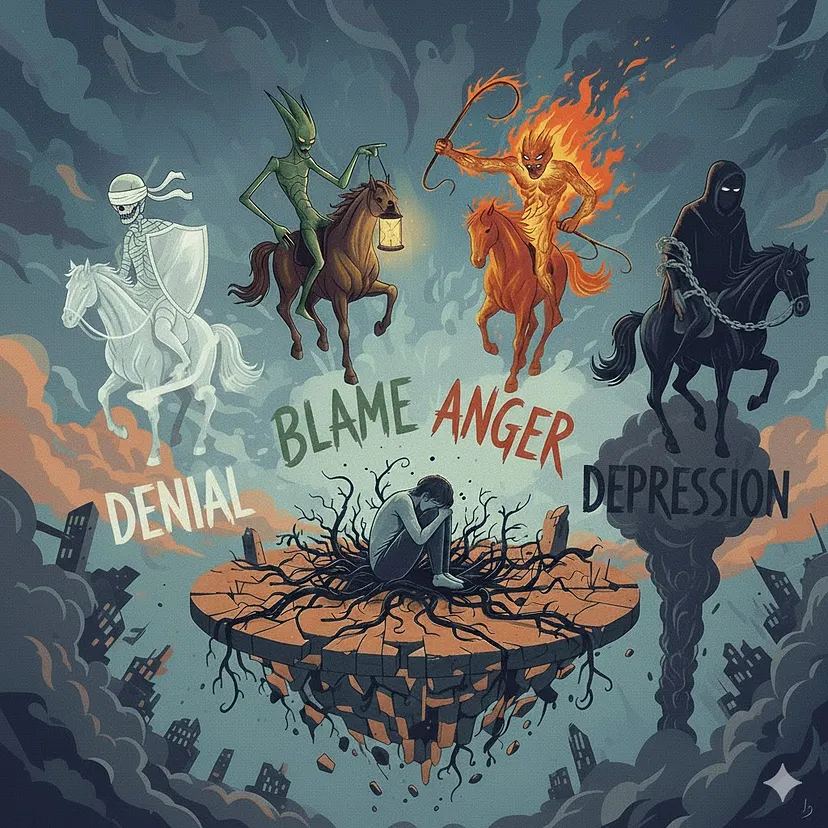
This psychological collapse is universal, but our reactions to it often determine whether the setback becomes a temporary wound or a permanent scar. When confronted by profound disappointment or failure, many individuals, driven by ego and fear, unconsciously call forth their own four riders. Instead of constructively grieving the loss and learning from the mistake, they summon the Four Horsemen of the Personal Apocalypse: Denial, Blame, Anger, and Depression.
These are sequential, self-destructive strategies that form a corrosive feedback loop. This cycle begins as a defense mechanism designed to protect the fragile ego, but quickly spirals into a pattern that destroys professional credibility, alienates loved ones, and permanently damages self-worth. To survive the personal apocalypse, we must first recognize the arrival of these four riders and the ruin they leave in their wake.
Horseman of Denial (The Blindfold)
The first horseman to arrive at the scene of the collapse is Denial. Denial is the initial, comforting refusal to acknowledge the failure or its actual severity. It is the subconscious ego slamming the door and insisting, “It wasn’t that bad,” “The numbers will turn around next quarter,” or “This is just a rough patch, it will fix itself.” This horseman rides on a wave of stubborn optimism, but its shield is built from pure delusion.
The core role of Denial is to postpone pain. By minimizing the disappointment, the individual seeks to maintain the illusion of control and competence. This stage often manifests as extreme avoidance and is the psychological equivalent of applying a tiny, decorative bandage to a gaping, infected wound.
The destructive impact of Denial is primarily paralysis. While the person is caught in the stasis of pretending nothing is wrong, the real-world consequences of the failure continue to grow. Denial prevents necessary course corrections, apologies, or self-reflection, ensuring that the mistake remains unlearned and the damage unaddressed. The initial failure, which might have been recoverable, becomes a guaranteed ruin because the person simply refuses to look at the wreckage long enough to begin rebuilding.
Horseman of Blame (The Scapegoat)
Denial, however powerful, is unsustainable. Reality eventually breaks through, and when it does, the fragile ego is left exposed. At this point, the individual desperately seeks a way to maintain their self-image as faultless, and so the second horseman of Blame rides in on the back of externalization.
Blame is the conscious, active pivot from self-deception to scapegoating. The internal dialogue shifts from “This didn’t happen” to “This happened, but it’s not my fault.” The failure is immediately and rigidly attributed to external forces: “My boss never supported me,” “The economy was against me,” “My partner was too demanding,” or even “The market was rigged.” The complexity of a failure is reduced to a simple, clean equation where the self is the victim, never the contributor.
The alienation of allies marks the destructive ride of the Horseman of Blame. When an individual blames, they actively push away the very people who might offer support. Friends and family who try to inject perspective or suggest personal responsibility are quickly viewed as critics, traitors, or part of the conspiracy that caused the failure. The person isolates themselves inside a protective, hostile narrative. Furthermore, Blame prevents genuine growth. By settling on an external enemy, the individual bypasses the painful but essential process of self-reflection. If the fault lies entirely with “them,” then there is nothing to change internally, guaranteeing the same mistakes will be made the next time a similar challenge arises. The Horseman of Blame ensures the personal apocalypse is not a singular event but a recurring cycle.
Horseman of Anger (The Firestorm)
Blame often provides temporary relief, but it is an unstable emotion. The tension between the accepted reality of failure (which Denial couldn’t hide) and the refusal to accept responsibility (Blame) fuels the third Horseman of Anger. Anger is the volatile emotional eruption, the firestorm that turns internal psychological dysfunction into external collateral damage.
This is the most visible and potentially the most damaging stage. Anger is not always a red-faced shout; it can be expressed through simmering resentment, sustained cynicism, passive-aggressive sabotage, or emotional distance. However it manifests, its purpose is to lash out, to punish the world for the pain the ego has been forced to endure. It can be directed at the specific scapegoat identified during the Blame stage, or it can be undirected, manifesting as a short fuse and disproportionate emotional responses to minor triggers.
The destructive impact of the Horseman of Anger is irreversible damage. This is where bridges are actively and often permanently burned. Professional careers are terminated following a public outburst. Marriages end after a string of verbally abusive attacks. The person, exhausted by the effort of maintaining the hostile narrative, burns their support system to the ground. This phase consumes vast amounts of psychological energy, leaving the individual depleted and emotionally threadbare. The constant state of fighting and lashing out drains their capacity for constructive thought, paving the way for the inevitable, final rider.
Horseman of Depression (The Retreat and Ruin)
When the energy of Anger is spent, and the tactics of Denial and Blame have conclusively failed to restore the lost status or repair the damage, the final Horseman of Depression arrives. This is the withdrawal, the apathy, and the total functional paralysis that follows the emotional firestorm. It is the emotional rock bottom.
Depression, in this context, is the consequence of the first three horsemen, but for some may be the first rider they run to calling on the other riders to cover their retreat. Either way, the individual seeks to be alienated. Denial ensures no early repair, Blame drives away allies, and Anger destroys the remaining support structure. Now, they are left with the full, raw weight of the original failure, compounded by the guilt and shame of the damage they caused by the ride of the other Horsemen.
The Horseman of Depression is by far the most dangerous by solidifying the personal apocalypse by ensuring total paralysis. When at the extreme, it manifests as deep, persistent fatigue, a loss of interest in activities that used to bring joy, and a pervasive sense of despair. The person becomes incapable of initiating the steps needed for rebuilding. They know they should seek a new job, apologize to a loved one, or start a new project, but the psychological weight is too heavy. They are stranded in the wreckage of their own creation, and the loss is no longer just the original failure, but the complete collapse of their motivation and functional life.
The Watchman’s Gaze: Recognizing the Horsemen
The cycle of the Four Horsemen is insidious precisely because it is driven by deeply ingrained defense mechanisms. The only way to stop the ride is to become The Watchman, recognizing the signs of each horseman, both in ourselves and in those we care about. This awareness is the first, most painful step toward breaking the pattern.
Recognizing it in Yourself (Internal Audit)
We can audit our own internal responses immediately after a failure. No one in the world is as harsh a critic as ourselves. This makes an internal audit challenging but not insurmountable. It also becomes easier with practice or when we work with a friend or counselor to get feedback on our thoughts.
Denial: Look for the voice that says, “If I just ignore it, it will fade away.” The key sign is a pervasive feeling of unearned calmness or the impulse to constantly change the topic when the failure is brought up. Be alert if your head is in the sand.
Blame: This is the automatic, immediate reflex to point the finger outward. You feel unfairly targeted by “the universe” or a specific person. The internal signal is a rigid thought pattern that excludes any personal contribution to the problem. Be suspicious if the failure narrative is always 100% external.
Anger: The internal audit reveals a short fuse and disproportionate emotional responses. You find yourself consumed by fantasies of confrontation or revenge, or an overwhelming need to be “right” and publicly criticize the “culprits,” using minor events as justification for major outbursts. Be on guard if you believe you should tear down those around you.
Depression: The most obvious internal sign is the sudden, persistent lack of appetite for life. This includes a total loss of interest in hobbies, persistent fatigue that sleep doesn’t resolve, and feeling a heavy, insurmountable weight upon waking. Be alarmed if you no longer feel you can move on in life.
Recognizing it in Others (External Audit)
Auditing others is difficult for a completely different reason. When trying to help others, it is easy to become the target of their externalizing. It takes patience, understanding, and perseverance as anyone riding with the Four Horsemen must make the decision themselves to get off.
Denial: They offer vague, overly optimistic statements that clash violently with the clear facts of the situation. They may be observed avoiding documents, calls, or meetings related to the setback or simply physically avoiding all together. Help them find ways to confront their fear of acknowledging the issue.
Blame: Their language is saturated with “They,” “The System,” or “If only X hadn’t…” They demonstrate a rigid refusal to discuss alternative causes or accept responsibility. They may start to treat you, the listener, as an adversary if you challenge their external narrative. Help them re-analyze and steer their frustrations to the root causes of the problem.
Anger: Watch for escalating hostility in routine discussions, not just arguments. This includes emotional volatility, intense cynicism, and passive-aggressive actions such as deliberately missing appointments, forgetting necessary details, or sudden ghosting of professional contacts. Help them channel anger into positive energy.
Depression: The external signs are visible social withdrawal and functional deterioration. This may involve missed work deadlines, neglect of personal hygiene or environment, sustained lethargy, and a general flatness of affect. Help them come back to the world and find purpose and joy.
The Antidote and Rebirth
The Four Horsemen of the Personal Apocalypse are a powerful team. They work in sequence, ensuring that a single failure leads to a catastrophic, compounding loss of relationships, opportunity, and self-esteem. Denial stalls the repair, Blame alienates allies, Anger burns the bridges, and Depression ensures the resulting isolation is permanent. This is how capable people dismantle their own lives in the face of adversity.
The good news is that these riders can be stopped, but they must be confronted directly, one by one. The antidote to the destructive cycle lies in replacing each horseman with its corresponding Pillar of Recovery:
Acceptance (Counter to Denial): Releasing the need to pretend. Accepting the failure as fact, regardless of how painful the reality is. This is the foundation of all subsequent action.
Responsibility (Counter to Blame): Distinguishing between fault and contribution. You may not be entirely at fault, but you always contribute. Acknowledging one’s role, however small, shuts down the externalized blame narrative and opens the door to learning.
Processing (Counter to Anger): Replacing lashing out with structured analysis and emotional release. This means talking to a trusted, neutral party, journaling, or engaging in physical activity, rather than inflicting pain on others.
Action/Rebuilding (Counter to Depression): Using the small victories of Acceptance, Responsibility, and Processing to initiate small, intentional steps forward. This counters paralysis with movement, proving to oneself that agency remains.
The personal apocalypse is defined not by the failure that triggers it, but by the choice we make in its aftermath. Do we allow the four horsemen to lead us to ruin, or do we stand as the Watchman, take responsibility for the terrain, and begin the difficult, vital work of rebuilding? The choice is always ours, but only once we recognize the riders approaching.



Comments