Mute the Noise and Amplify Your Focus
- thinklivechoose
- May 23
- 7 min read


Motion vs. Progress
Warren Buffett once remarked, “The difference between successful people and very successful people is that very successful people say no to almost everything”. That single statement holds a clear truth: success is not built by doing more, but by doing less with greater intention.
In our modern world, the opposite seems true. We wear busyness like a badge of honor. Our calendars are packed, our inboxes overflow, and our days blur into endless streams of meetings, emails, and tasks. Yet, at the end of the day, many of us are left wondering what we accomplished.
Here lies the problem: we confuse motion with progress and equate activity with achievement.
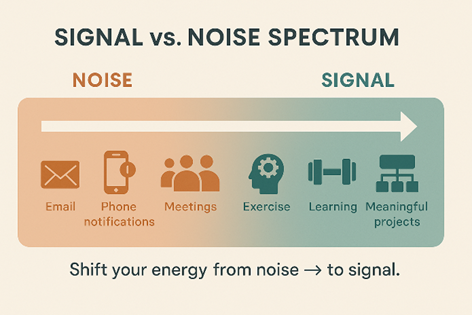
Not all tasks are created equally. Some drive us forward, while others simply create noise. To break free from this loop, we must master a critical filter: signal vs. noise.
Signal: The high-impact tasks that create outcomes, progress, and meaning.
Noise: The distractions, busywork, and low-value activities that drain time and energy.
Regardless of your position in an organization, if you and your team focus on reducing to 3 to 5 key signal tasks per day, you dramatically increase productivity, clarity, and long-term success.
The Science and Psychology of Focus
Narrowing your day to 3 to 5 essential tasks is not just motivational advice; it is backed by science.
Cognitive Limits: Research shows that humans are capable of only 4 to 5 hours of deep focus per day. Not at once mind you, total. On top of this, human memory is strictly limited in holding at most 3 to 5 chunks of information. After that window, the ability to think critically and creatively drops significantly. Trying to stretch beyond this limit results in diminishing returns and mental fatigue.
Decision Fatigue: Every choice we make depletes mental energy. A day filled with dozens of small, low-value decisions leaves us too drained to tackle important work.
The Zeigarnik Effect: Unfinished tasks occupy mental real estate. Incomplete tasks create mental tension that keeps us distracted.
Attention Residue: Switching between tasks leaves fragments of your attention behind rather than just dividing your focus. Every time you switch tasks, part of your mind lingers on the previous activity, which lowers performance.
Constraints and Performance: Limits can create freedom. Studies in psychology show that when people narrow their focus to fewer priorities, success rates rise.
Your brain is wired for focus, not chaos. Focusing your effort on 3 to 5 task a day aligns with how people are built to perform.
Defining the Signal: What Are Your 3 to 5 Daily Wins?
Not all tasks deserve your focus. To separate signal from noise, you need clarity. Defining a true signal requires you to slow down, block out external pressures, and pay attention to your internal world. When you listen to what is happening internally, you can find actual alignment rather than just reacting to outside demands.
Signal tasks share three specific qualities:
They move toward your most important goals.
They involve deep work, which includes activities that require concentrated thought, creativity, or problem-solving.
They align with your long-term vision and values.
Examples of daily signal tasks include:
For someone in business: Pitch to two clients, write product copy for a new launch, or review financial projections.
For a student: Complete a full essay draft, study two chapters of core material, or outline a research project.
For the head of a team: Coach a team member, review quarterly strategy, or analyze key metrics.
The key is to identify your non-negotiables. These are the tasks that matter most, no matter what else comes up during the day. Everything beyond them is optional.
When you begin framing your day around these signals, you shift from reaction to intention. Your to-do list stops being a trap and becomes a tool.
Recognizing and Reducing the Noise
If the signal is what drives progress, noise is what holds you back. The primary difficulty in eliminating noise is that it rarely looks like a distraction; instead, it frequently disguises itself as productivity.
You can easily spend an entire day answering messages, attending sessions, and updating spreadsheets or handling a crisis. You feel exhausted at the end of the day, which makes you believe you were highly productive. However, checking off 30 small items on a to-do list means very little if none of those actions actually drive long-term outcomes. To filter your day effectively, you must learn to recognize the common forms that noise takes.
The Three Common Categories of Noise:
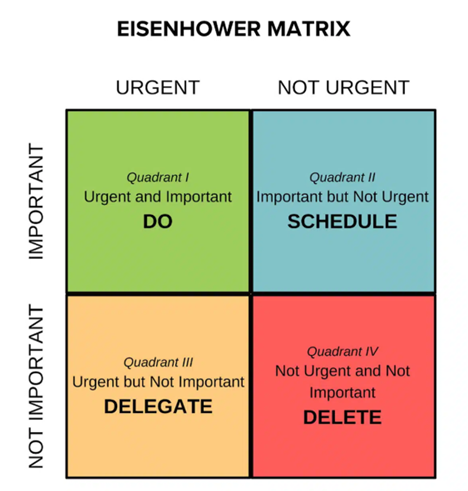
The Non-important Urgency Trap: These are tasks that demand immediate attention but are important or create lasting progress. This category includes constant notifications and endless email threads that pull you away from deep focus. Most people remain trapped reacting to the urgent and rather than invest time in the important.
Shallow Performance: This involves over-planning, over-analyzing, and reorganizing schedules without moving into actual execution. It provides the illusion of control while delaying the actual work that requires cognitive effort.
Unstructured Collaboration: This includes meetings with no clear purpose, vague agendas, or conversations that do not result in concrete decisions. These activities consume high energy hours while producing minimal returns. This category gets tricky because humans do need unstructured time to build relationships, which is highly important, but can come at a cost if too often.
President Dwight D. Eisenhower famously distinguished between the urgent and the important. Urgent tasks demand immediate attention but rarely create lasting progress. Important tasks are the signals, which are the ones that truly shape outcomes. Most people are trapped in the urgent and rarely step into the important.
How to Cut the Noise:
Time Blocking: Reserve your peak energy hours for signal tasks.
Silence Notifications: Protect your focus windows.
The No List: Write down tasks, meetings, and requests you will deliberately decline.
Delegate and Automate: Free yourself from repetitive, low-value work.
Noise reduction is not about becoming antisocial or inflexible; instead, it is about reclaiming your attention for what matters most.
Leadership and the Signal Advantage
Leaders face distinct challenges because they not only can create noise for themselves, but for their entire team. A leader's responsibility extends beyond managing personal time; it involves protecting the collective focus of the entire team. Effective leaders excel by filtering through the distractions and staying anchored to priority tasks.
A leader exists to support and give direction to a team, so their top task must be cutting noise and giving a clear signal of priority. They should act as a shield, preventing unnecessary distractions from external sources, or themselves, from disrupting the core work of the team. This deliberate focus brings a steady presence giving the team clear permission to eliminate multi-tasking and maximize their focus.
This is not just about front-line leaders and managers. This scales all the way from high-level strategy to daily operations. For example, Jeff Bezos had famously noted that Amazon’s success came from focusing on three big things each year and his goal is three good decisions a day. When leaders focus on fewer, more meaningful priorities, their teams gain alignment and confidence.
To operationalize focus, one way is to replace traditional status updates with a structured alignment sync at the start of each week.
Define Team Signals: The leader outlines the three major outcomes the team should achieve by the end of the week. This step gives the team clear direction and certainty.
Flag the Noise: Team members highlight specific administrative tasks, unnecessary meetings, or external requests that threaten to disrupt their focus and ability to meet the timeline.
Protect Team Capacity: The leader uses this information to clear obstacles, reassign low-value tasks, or cancel non-essential sessions, acting as a shield for the team's time.
Alignment requires organizational support and prioritization. If everything is a top priority, nothing is so a leader having clear priorities and establishing structural boundaries eliminates constant task-switching and frees up the mental space required for long-term strategic thinking and high-impact project execution.
Compounding Effect of Focus
The true value of reducing your focus to 3 to 5 tasks lies in compounding outcomes. Three high value tasks completed a day turn into 1,095 high-impact actions taken in a year. This represents more than a thousand meaningful steps toward your goals; all built one day at a time.
A writer who commits to 500 words a day finished a book in months instead of years.
An athlete who practices three focused skills each day achieves mastery over time.
An entrepreneur who concentrates on the key pillars of a new business gets it off the ground instead of running around putting out self-inflicted fires.
It does not take extraordinary people; instead, it takes an ordinary person who masters focus.
“Success is not about doing more. It’s about doing what matters.”
The compounding effect of focus means greatness is not built overnight; rather, it is built daily through discipline and clarity.
Creating a Daily Practice
Theory only matters if it becomes practice. Here is how to live the with a good signal:
Write Down Your Signals first thing. Each morning, list the 3 to 5 tasks that will define a successful day.
Prioritize by Impact. Rank them by importance, not convenience.
Time Block Early. Schedule your signal tasks in the first half of the day, before distractions creep in.
Keep a Noise Log. Every time you are pulled off track, jot it down. Over time, you will see patterns and learn to preempt them.
Reflect Daily. At the end of the day, review whether you completed your signals. Identify what got in the way and adjust your approach for tomorrow.
Remember that the goal is consistency, not perfection. Missing a day is not failure; instead, it is simply feedback. The compounding effect only works if you keep showing up.
Stay Focused
Focus is the ultimate multiplier. It is not about squeezing more hours into your day; instead, it is about directing your energy toward what counts.
Here is the challenge: for the next seven days, write down and complete 3 to 5 key signal tasks each day. Protect them, prioritize them, and reflect on them. At the end of the week, ask yourself if you feel more progress, clarity, and control.
The answer will likely be a resounding yes. In the end, you do not need more time; you need more signal.
Shift your energy from noise to signal.



Comments