Parkinson’s Law and Building Fences
- thinklivechoose
- Apr 24
- 9 min read


In my early days as an analyst, I once worked on a project for 6+ months, for it to solve no problems and go nowhere. When looking at the downfall of this project it lacked clarity of task, had vague requirements and little to no deadlines. I had no boundaries and no fences to keep me and my task on track, so I roamed miserable and bored. I was not experienced or mature enough to build my own milestones and timelines, and my leadership did not feel the need for structure and did not understand the damage they were causing to the team. This project was badly managed, poorly executed and fell into the time expansion trap of Parkinson’s Law.
Parkinson’s Law was first coined by Cyril Northcote Parkinson in a 1955 essay for The Economist. While it began as a critique of bureaucratic growth, it has since become a cornerstone of behavioral psychology and productivity theory.
At its core, the law states: “Work expands so as to fill the time available for its completion.”
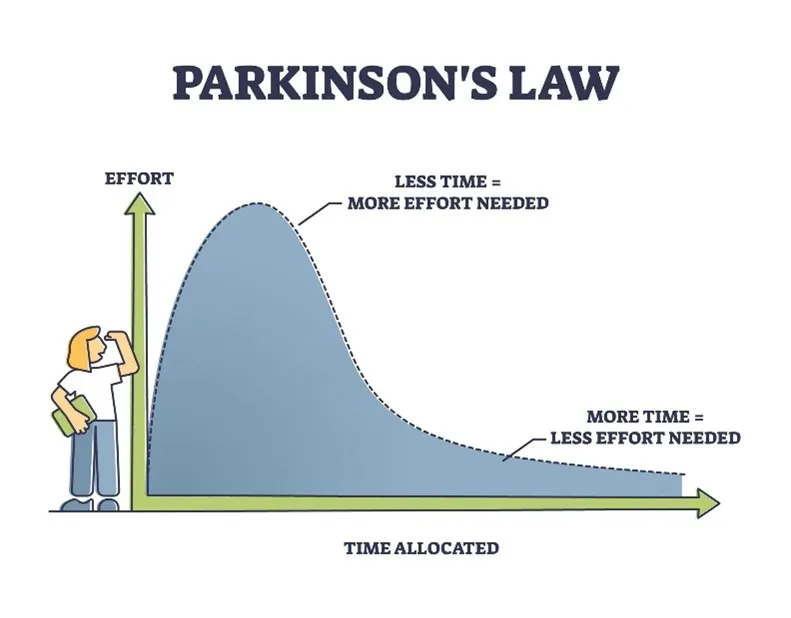
Think of work not as a solid object, but as a gas. If you pump a liter of oxygen into a small canister, it fills the canister. If you pump that same liter into a massive auditorium, the gas will expand until it touches every corner of the room. It is the same amount of oxygen, but it has become thinner, less concentrated, and less potent.
When we give ourselves a six-month window for a project that requires six weeks of actual effort, we aren’t “giving ourselves breathing room.” We are effectively thinning out our cognitive focus across a massive, empty calendar. This causes individual and organizational impacts. We must recognize that setting immutable, specific deadlines is not an act of self-restriction, but the most effective psychological and structural defense against task expansion.
The Psychological Drivers: Why We Expand
Why does the human brain struggle so much with open-ended timelines? Several psychological factors are at play:
The Value Fallacy: We often subconsciously equate “time spent” with “quality produced.” We feel that if a task only took twenty minutes, it must be “cheap” or “unprofessional.” To justify the importance of our work, to ourselves and our stakeholders, we over-complicate the process to fill the allotted time.
Complexity Bias: When given too much time, the brain seeks to solve problems that don’t exist. We begin focusing on minute, trivial details that add 1% of value but consume 80% of the remaining time.
The Loss of Scarcity: Urgency is a powerful cognitive filter. It forces the brain to distinguish between “critical” and “nice to have.” Without a looming deadline, everything feels equally important. This lack of scarcity leads to “decision fatigue,” as we spend hours debating minor points that a tighter deadline would have forced us to ignore.
The High Cost of “Later”
Parkinson’s Law is not merely a quirk of time management; it is a corrosive force. When tasks are allowed to expand, they don’t just take up more space on a calendar. They actively degrade the quality of the work, the health of the organization, and the psychological well-being of the individual.
The Individual Impact: From Burnout to “Rust-out”
We often talk about burnout, the result of too much pressure for too long. However, the Expansion Trap leads to its equally dangerous sibling: rust-out.
The Erosion of Self-Efficacy: When a project lacks a clear deadline and a defined “done” state, the individual loses the psychological “win” of completion. This creates a state of perpetual “doing” without “achieving,” which eventually erodes a person’s belief in their own competence.
The Skill Decay: High performers thrive on the “flow state”, the intersection of high challenge and high skill. When a task that should take a week is stretched over a month, the challenge disappears. The mind goes soft. Like an athlete who stops training, an analyst or leader who isn’t forced to prioritize sharpens no skills. They simply learn how to look busy.
The “Defeated Analyst” Syndrome: You know when you time is being wasted. Many individuals have a drive for their work to mean something and have purpose. Misery is generated when time is wasted day in and day out. There is a profound psychological weight to knowing that your effort is being poured into a vessel with no bottom.
The Organizational Impact: The Death of Productivity
For an organization, Parkinson’s Law is a silent budget killer. It manifests in three primary ways:
The Opportunity Cost of “Busywork”: Every hour a team spends “polishing the banister” of a low-priority project is an hour they are not spending on innovation or crisis response. The cost isn’t just the salary paid for that hour; it is the compounded value of what could have been achieved if the team had been freed up four months earlier.
Cultural Dilution: When leadership fails to set immutable deadlines, it sends a message: Speed doesn’t matter. This creates a culture of “deliberation over delivery.” Once a culture loses its sense of urgency, it is incredibly difficult to regain. Teams begin to prioritize the process (meetings, status reports, consensus-building) over the outcome.
The Proliferation of “Shadow Tasks”: In a vacuum of urgency, bureaucracy breeds. More people are brought in to “review” the expanding project. More meetings are scheduled to “align” on vague requirements. Eventually, the project becomes so heavy with its own administrative weight that it stops moving entirely. The momentum stops not because the work is hard, but because the friction of the expanded timeline has become insurmountable.
The Culprit: A Symbiotic Failure
When a project dissolves into month long voids of productivity, the natural inclination is to point fingers. The manager blames the individual’s lack of initiative; the individual blames the manager’s lack of direction. The reality is it is a symbiotic failure. It is a feedback loop where both parties contribute to the inertia.
The Manager’s Sin: The “Vagueness Trap”
Leadership often mistakes “vague requirements” for “autonomy.” They believe that by not setting a hard deadline, they are being “flexible” or “trusting.” In reality, they have abdicated their primary responsibility: defining the container and building the fence.
The Lack of “Done”: If a leader cannot articulate exactly what success looks like, the individual is forced to guess. To avoid being “wrong,” the individual keeps working, keep researching, and keep expanding.
The Comfort of Stasis: For some managers, a project that is “in progress” is safer than a project that is “delivered.” Delivery invites scrutiny and criticism. An expanding project allows a manager to report that “work is ongoing” without ever having to defend the results.
The Individual’s Sin: The “Maturity Gap”
On the other side of the desk, the individual, especially those early in their career, often lacks the professional maturity to create their own pressure.
The Passive Passenger: There is a certain comfort in a vague deadline. It removes the “scary” pressure of immediate accountability. Without the maturity to set self-imposed milestones, it is easy to default to the pace of the environment.
The Fear of Idleness: We have been conditioned to believe that “busy” equals “valuable.” If an analyst finishes a task in two weeks but was given two months, they fear that being “done” early will simply result in more work, or worse, a realization from leadership that the task wasn’t that hard to begin with. So, they expand the work to protect their “busyness.”
The “Expansion Loop”
The most dangerous scenario occurs when a “hands-off” manager meets a “passive” employee. The manager doesn’t ask for updates because they don’t want to micromanage. The employee doesn’t provide updates because they don’t want to admit they are stuck or bored.
This creates a conspiracy of silence. Both parties are aware the project is going nowhere, but neither is willing to introduce the “necessary pressure” of a hard deadline to fix it.
The Art of Self-Management
If you find yourself in the “Time Expansion Trap” because of a hands-off manager or a vague organizational culture, you cannot afford to wait for a rescue. Waiting for someone else to define your time is a recipe for the “rust-out” discussed earlier. To defeat Parkinson’s Law, you must become your own architect of friction. The goal is to transition from being a passive recipient of time to an active engineer of urgency.
Artificial Scarcity
The most effective way to combat an over-generous timeline is to ignore it. If you are given five weeks to complete a task, commit to four.
The Psychology of the Buffer: By artificially shortening the deadline, you force your brain into the “prioritization” phase much earlier. You stop asking, “How can I fill this time?” and start asking, “What are the 80% of results I can get with the first 20% of effort?”
The “External” Anchor: Don’t just keep this deadline in your head. Tell a colleague, “I’ll have a draft to you by Thursday,” even if the official deadline isn’t until the following Tuesday. Public commitment creates the necessary social pressure to maintain the pace.
Aggressive Milestone Mapping
Parkinson’s Law thrives in the “middle” of a project. That vast, gray area between the start date and the final deadline. You must eliminate the middle by breaking the project into “Micro-Deliverables.”
Define “Done-Done”: For every micro-task, define what “finished” looks like in a single sentence. If you can’t define “done,” the task will expand indefinitely.
The Friday Finish: Aim to have a tangible, reviewable “win” by the end of every week. This provides the psychological dopamine hit of completion and prevents the “defeated analyst” feeling.
Forcing the Feedback Loop
Vagueness is the oxygen of expansion. To kill it, you must demand clarity through “Proactive Reporting.”
The “This is what I’m doing” Email: If your manager hasn’t set a deadline, send an email saying: “I’ve broken this project into three phases. I plan to have Phase 1 complete by Friday. Please let me know if this timeline doesn’t align with your priorities.” * Assuming Authority: By proposing your own timeline, you are doing the manager’s job for them. Most “hands-off” managers will simply agree, giving you the “immutable deadline” you need to stay sharp.
The “Minimum Viable” Mindset
You must adopt the software engineering concept of the Minimum Viable Product (MVP). What is the simplest deliverable that answers the task, build that first. Anything added after that point is a luxury, not a necessity. If you finish the MVP early, you haven’t “failed” the time requirement; you’ve gained the freedom to move on to higher-value work.
The Leader’s Mandate to Engineer the Fence
If the individual’s role is to manage their own energy, the leader’s role is to act as the architect of the fence. To prevent Parkinson’s Law from rotting an organization from the inside out, leaders must move from being passive observers to active engineers of urgency.
Leadership is not about “watching people work”; it is about managing the scarcity of time.
Precision as a Tool of Command
Vague requirements are the oxygen that allows Parkinson’s Law to breathe. When a leader says, “Take a look at this and let me know what you find,” they have effectively invited an infinite expansion of effort.
Define the “Done” State: A leader must be able to articulate the exact output required. Instead of a generic “research a topic,” the task should be specific to the action, expected output for completion.
The “Constraint-First” Briefing: Start every project by defining what won’t be done. By narrowing the scope, you force the team to focus their intensity on the critical path rather than wandering into the weeds.
The “Minimum Viable Time” (MVT)
A leader should ask their team: “What is the shortest amount of time we need to produce a version that provides value?”. From here developing the micro deadlines keeps momentum flowing.
Sprints, Not Marathons: Break long-term goals into two-week “sprints.” It is much harder for work to expand when the deadline is always ten days away.
70% Solutions: Encourage the team to deliver a 70% solution. Then take this solution and refine it to the final product. If you expect your team to deliver perfect, they will waste time “polishing the banister” instead of getting feedback and reiterating.
Rewarding Efficiency, Not “Presence”
One of the primary reasons individuals allow work to expand is the fear that finishing early only results in more work. This is a cultural failure.
The “Early Finish” Dividend: If a team finishes a six-week project in four weeks with high quality, give them the “dividend” Allow them to use a portion of that saved time for professional development, creative “blue-sky” projects, or simply time off.
Kill the “Busy” Aesthetic: Leaders must explicitly devalue the appearance of busyness. Publicly praise the analyst who finds a way to automate a task in two hours rather than the one who “grinds” through it for twenty.
Establishing “Structural Defenses”
Deadlines are not acts of self-restriction; they are defenses for your team.
Immutable Milestones: A deadline is only a defense if it is real. If deadlines are constantly pushed back “just because,” the psychological urgency vanishes. Leaders must treat milestones as sacred, forcing the team to make the hard trade-offs in scope rather than trade-offs in time.
The “Cadence of Accountability”: Establish short, check-ins (15 minutes or less) where the focus is strictly on “What was finished since yesterday?” and “What is blocking the next win?” This allows updates with changing guidance and puts leaders on the path to solving problems blocking the team’s progress.
The Freedom of the Fence
Looking back at that analyst who spent six months adrift in a sea of vague requirements, I realize I wasn’t just suffering from a lack of management. I was suffering from a lack of containment. Without walls, my effort had no choice but to evaporate.
We must stop viewing deadlines as shackles. In a world of infinite distractions and expanding tasks, a deadline is the most compassionate thing a leader can give their team and the most professional thing an individual can give themselves.
Deadlines are not restrictions; they are structural defenses for your focus. They are the fences that keep our creative and analytical energy from wandering into the weeds. They force us to choose the vital over the trivial, the “good enough” over the “endlessly polished,” and the finished over the infinite.



Comments