Getting To Yes: Fighting Institutional Resistance to Action
- thinklivechoose
- Aug 9
- 6 min read


In high risk operational environments, institutional inertia and self-imposed bureaucracy frequently dictate the boundaries of what leadership considers possible. When faced with complex or unconventional challenges, large organizations routinely default to administrative refusal. Decision-makers cite established policy, limited resource allocation, or conflicting jurisdictional mandates as insurmountable barriers.
Over time, this passive acceptance creates a culture of learned helplessness, where administrative friction is routinely mistaken for absolute impossibility.
I once worked in an elite organization tasked with solving some of the most complex operational problems in the country, the boundary between the possible and the impossible was tested daily. We were taught a truth about organizational dynamics: most barriers are self-created constructs rather than fixed realities.
To fight this, we were all taught the mantra “Get to yes”.
To an outside observer, our organization appeared to operate through one of two distinct modes. To some, we were innovative problem-solvers who consistently devised out-of-the-box methods to overcome technical and strategic hurdles. To others, we were administrative bulldozers that entered an organization, demanded immediate access, claimed necessary resources, and forcibly displaced anyone who slowed forward progress. Depending on the complexity of the challenge and the degree of institutional pushback, both descriptions could be accurate.
The unifying force behind both approaches was that core operational mantra established from day one: find a way to get to yes.
This directive was not an endorsement of reckless non-compliance or belligerent force. Instead, it was an absolute refusal to accept that external constraints were holding us back, combined with a recognition that we are often our own worst obstacle. Across government and corporate enterprises, people build bureaucracies, establish restrictive guidelines, and then forget that they possess the authority to modify them. When faced with novel demands, organizations point to these self-authored rules to justify saying no, asserting that an objective cannot be done or is simply not allowed.
Reversing this mindset requires a systematic framework for evaluating rules, authority, and resources. By moving away from reflexively accepting barriers, leaders can analyze resistance, separate true legal or ethical constraints from mere policy friction and establish clear pathways toward execution.
Institutional Resistance to Yes
To dismantle organizational barriers, one must first understand why administrative structures naturally gravitate toward refusal. Institutional resistance is rarely the result of malice or active opposition; rather, it is the predictable output of risk-averse systems designed to preserve stability at the expense of adaptation. Over time, policies originally crafted to solve specific historical problems solidify into rigid cultural norms. These procedural guardrails become absolute boundaries, giving rise to an environment where pointing to a regulation becomes a convenient shield against accountability. This dynamic creates the dissonance gap between how an organization presents itself (happy to help) and how it actually operates.
The inclination to say no stems from three primary structural drivers:
Diffused Responsibility: In complex bureaucracies, authorization often requires consensus across multiple departments. Because no single entity possesses total ownership, individuals naturally default to withholding approval to protect their immediate domain from risk.
Confusing Policy with Precedent: Organizations routinely mistake temporary guidelines for permanent directives. Personnel frequently claim a task is not allowed simply because it has never been attempted through a non-standard channel.
Self-Imposed Constraints: Agencies and enterprise teams frequently layer internal compliance mandates on top of statutory requirements, eventually forgetting which rules are legal obligations, and which are merely self-created policies.
Overcoming these drivers requires leaders to carefully audit every administrative denial. When confronted with assertions that an objective is impossible or unauthorized, the immediate task is to isolate the specific origin of that restriction. Is the limitation grounded in hard legal statutes, or does it exist solely within internal policy that can be waived, updated, or reinterpreted?
The Three Pathways to Get to Yes
When an outside entity observes an organization achieving extraordinary outcomes, the visible surface area suggests either brilliant innovation or blunt operational force. Observers witness a team implementing sophisticated, unconventional strategies or physically clearing administrative roadblocks to secure access and resources. What remains unseen is the deliberate analytical discipline required to evaluate institutional friction before taking action.
Navigating complex institutional landscapes requires a structured method to categorize and resolve friction. When presented with a complex objective, leaders must avoid treating all administrative pushback as a single, homogenous barrier. Instead, every initiative must be evaluated based on four fundamental operational variables: stakeholder alignment, required permissions, statutory authority, and available resources. Depending on the state of these variables, execution follows one of three distinct pathways.
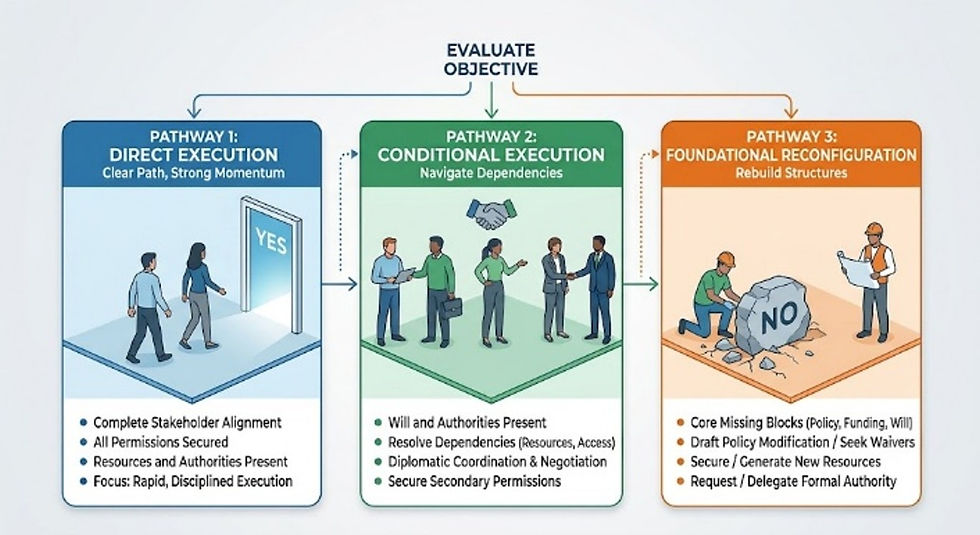
Pathway 1: Direct Execution
The first pathway represents complete alignment across all four variables. In this operational state, the necessary authority exists, official permissions are secured, resources are allocated, and key stakeholders possess the institutional will to move forward. There are no policy roadblocks, jurisdictional conflicts, or technical access barriers standing between the team and the objective.
While this appears to be the simplest operational environment, it carries its own specific risks. Organizations accustomed to administrative friction often over-engineer solutions even when a clear path exists. Leaders in this phase must prevent scope creep, avoid inviting unnecessary oversight that creates new delays, and focus entirely on rapid, disciplined execution. The primary directive under this path is to exploit the open pathway immediately before external conditions shift or administrative momentum stalls.
Pathway 2: Conditional Execution
The second pathway occurs when the foundational mandate and authority exist, but operational progress is halted by specific dependencies. The broader organization supports the end state, yet progress requires navigating a series of tactical friction points. Common dependencies include:
Jurisdictional Deconfliction: Ensuring the initiative does not disrupt ongoing operations led by parallel units or partner organizations.
Access Control: Securing necessary database permissions, system authorizations, or facility access.
Stakeholder Management: Addressing individual inter-agency rivalries, calming professional egos, and securing informal buy-in from key gatekeepers.
Navigating this pathway requires negotiation, diplomatic alignment, and tactical coordination rather than policy reform. Leaders must break down the broader objective into specific, conditional steps. Rather than accepting a preliminary rejection, the team identifies the exact conditions under which the answer becomes yes. Execution proceeds by systematically addressing each prerequisite, securing secondary permissions, and resolving resource deficits one by one until the initiative transitions into direct execution.
Pathway 3: Foundational Reconfiguration
The third pathway is engaged when an initiative encounters structural blockage. In this state, one or more core variables are entirely absent: institutional will is lacking, policy explicitly prohibits the intended action, or required authorities and funding streams do not exist. This is the scenario where conventional teams stop, declare the objective impossible, and report back that the system will not allow progress.
Reaching the Yes outcome along this pathway requires shifting focus from operational execution to structural reconfiguration. Before primary operations can begin, leaders must address the underlying framework by:
Policy or Rule Modification: Drafting updates, petitioning for administrative waivers, or reinterpreting existing regulations based on updated requirements.
Resource Generation: Reallocating existing funds, securing emergency financial backing, or forming inter-agency partnerships to pool necessary assets.
Delegation of Authority: Requesting formal transfers of operational authority or establishing new legal frameworks to legitimize the mission.
This pathway demands patience, strategic positioning, and a thorough understanding of organizational governance. An initial lack of authorization is not treated as a final outcome; it is treated as a list of missing prerequisites that must be built before the primary effort can launch.
Strategic Implementation and Leadership Mindset
Instilling an operational mindset focused on reaching affirmative outcomes requires deliberate leadership, structural clarity, and continuous reinforcement. Left unmanaged, an insistence on overcoming obstacles can devolve into reckless non-compliance or counterproductive aggression. The goal is not to cultivate an environment that ignores rules, but to build an organization capable of rigorously analyzing constraints, identifying authority, and ruthlessly pursuing legitimate solutions.

To maintain balance, leaders must implement specific practices that guide problem-solving while keeping teams grounded in organizational integrity:
Distinguish Hard Legal Boundaries from Soft Policy Friction: Ensure personnel clearly understand the difference between immutable legal constraints and flexible internal guidelines. True statutory or ethical boundaries are absolute; internal policies, administrative procedures, and historical habits are subjects for evaluation and potential modification.
Reward Initiative Over Passive Compliance: Shift performance metrics to value problem-solving and structured initiative. When a team member encounters a roadblock, praise efforts that analyze underlying causes and offer actionable workarounds rather than simple reports of failure.
Build Cross-Functional Alliances: Reaching affirmative outcomes often depends on relationships outside the immediate command chain. Cultivate strong working partnerships with legal advisors, finance managers, policy writers, and external stakeholders long before critical operations commence.
By embedding these principles into daily routines, leaders foster a resilient culture where teams instinctively seek solutions. Teams learn to treat bureaucratic resistance not as an insurmountable barrier, but as an operational variable to be analyzed, managed, and systematically overcome.
This is the Way
Achieving consistent, high-impact results in complex institutional settings requires dismantling the habit of passive acceptance. While bureaucratic friction, procedural habits, and administrative precedents are present in every large organization, they rarely mark the true boundaries of what is possible. Most operational limits are self-imposed constructs born from risk aversion, fragmented responsibility, and a reliance on outdated practices.
Leaders and teams can move past superficial refusals and transform vague institutional resistance into actionable operational paths. Whether navigating open avenues, resolving conditional dependencies, or actively rebuilding foundational policies, success depends on an unwavering commitment to finding a way forward.
In demanding environments, organizational inertia will always push toward the status quo. Reaching meaningful success requires maintaining the discipline, creative vision, and operational determination to continuously strive for affirmative outcomes, ensuring that internal hesitation never dictates external achievement.
In the end, get to yes.



Comments