The Sun Tzu Leadership Series: An Introduction into Turning Sun Tzu into Lessons of Leadership
- thinklivechoose
- 5 days ago
- 8 min read


Sun Tzu's Timeless Insights
In today's world, leadership advice is often a blur of passing buzzwords. Every business quarter brings a new catchphrase: radical disruption, hyper-agile pivots, fail-fast mindsets, or AI optimization. Modern managers are constantly pushed to move faster, broadcast their visions everywhere, and treat office life as an endless, exhausting sprint.
Yet beneath all this corporate noise lies an obvious contradiction. Despite having real-time analytics, automated communication apps, and massive computing power, small business to large companies to governmental organizations struggle with the exact same problems that have plagued human groups for thousands of years.
Teams still burn out from long, pointless friction. Big initiatives still fail because of executive pride. Companies still blow through millions of dollars attacking entrenched problems and rivals, only to inherit debt and broken morale. Middle managers still hide in defensive silos the moment trust and psychological safety disappear.
When modern business frameworks fail to fix these basic flaws, the answer is rarely to invent another trendy management fad. The better approach is to look outside the modern echo chamber and consult foundational texts that have survived centuries of human experience.
At the very top of that list is the twenty-five-hundred-year-old classic attributed to Sun Tzu: The Art of War.
While it would be easy to misinterpret The Art of War as a cutthroat guide to cutthroat corporate combat, it is actually something far deeper: a practical, humane philosophy of systems thinking, organizational psychology, and executive self-control.
When you strip away the ancient references to chariots, spearmen, and mountain passes, Sun Tzu’s thirteen chapters offer a complete blueprint for modern leadership.
Why It Still Matter
Why should an executive, project manager, or team lead in the twenty-first century spend time studying an interpreted rewrite of an ancient Chinese scroll?
The answer comes down to the difference between temporary tools and unchanging human rules.
Tools change quickly. Moving from ancient signal gongs to modern Slack channels is a massive technological upgrade, but the underlying leadership problem of “how do you coordinate a large group of people without confusing the message?” remains the exact same.
Shifting from ancient grain carts to modern digital supply lines changes the asset, but the basic economic rule that dragged-out, poorly paced projects burn through resources faster than they generate value never changes.
Classic literature acts as an intellectual testing ground. A book does not survive twenty-five hundred years just because it is clever; it survives because it tells fundamental truths about human behavior, operational friction, and how power works under pressure.
By translating this work into a modern leadership lens we can distill these fundamental strategic concepts into modern leadership lessons:
Moral Law (Tao) becomes a discussion on Purpose, Ethics & Trust
Heaven & Earth (Teien & Di) becomes a study on Market Climate and Industry
The Commander (Jiang) becomes lessons in Character and Maturity
Methods and Discipline (Fa) becomes the pillars of Infrastructure and Systems
Preservation (Quán) becomes guidance on preventing Burn Out
Formlessness (Water) steers us into the importance of Adaptability and Agility
These core ideas then suddenly turn into real-world business realities:
From Direct Conflict to Value Preservation: Moving away from trying to destroy rivals, and focusing instead on building internal strength so your business doesn't need to fight destructive turf wars.
From Forcing People to Inspiring Alignment: Moving away from authoritarian, top-down control and instead creating a culture where shared purpose naturally brings out people's best work.
From Reckless Action to Deep Planning: Replacing frantic, ego-driven reactions with quiet, careful preparation.
Seen this way, Sun Tzu’s work is not a manual for fighting wars; it is a guide for building resilient, self-aware organizations that are structurally designed to succeed.
The Three Core Takeaways from Sun Tzu
This article is the beginning in a series breaking down each chapter of The Art of War.
Across all thirteen articles, three main principles stand out. These ideas form the backbone of what we will call the 3 Truths of Leadership Mastery:
1. Great Strategy Stops Crises Before They Start
Modern leadership culture loves to reward dramatic rescues: the manager who pushes through an emergency restructuring, the engineer who stays up for three straight days to fix a server, or the CEO who wins a messy lawsuit.
Sun Tzu offers a needed reality check: the best leaders succeed so smoothly that their wins rarely look dramatic or daring.
They fixed system design flaws while they were still minor issues; they brought the team together before small disagreements turned into toxic politics; they built up safety reserves before the market turned sour. The goal of smart strategy is not to win dramatic, high-stress battles, but to make those battles unnecessary in the first place.
2. Real Leadership Combines Genuine Empathy with High Standards
Business advice often sets up a false choice: you either have a warm, people-first workplace or a demanding, results-driven culture of accountability.
This is a false trade-off. Sun Tzu explains that lasting authority requires both Wen (humanity, empathy, and psychological safety) and Wu (structure, high standards, and consistent accountability).
Empathy without discipline creates a disorganized, fragile team where nobody is held accountable.
Discipline without empathy creates fear, quiet quitting, and resentment.
A strong leader cares deeply about the personal growth and well-being of their people while keeping performance standards crystal clear.
3. Real Foresight Comes from a Connection with Frontline Workers and Managers
In a world full of automated dashboards, predictive models, AI chatbots and big data, executives easily become disconnected from what is actually happening on the ground. They end up managing abstract numbers on a screen rather than real-world operations.
Sun Tzu’s final warning in his book reminds us that real foresight cannot come from detached calculations or recycled historical charts alone. True insight comes from staying close to the work: walking the floor, listening to front-line staff describe their everyday bottlenecks, encouraging open and honest feedback, and understanding the human side of the company.
The Thirteen Chapters of Leadership Mastery
To turn these classic insights into a clear, actionable guide for today's leaders, each future article takes one specific chapter and extracts its core management lessons, psychological insights, and leadership checklists. Here is an overview of the entire series:
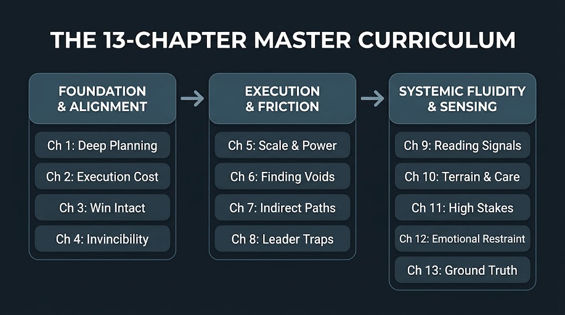
Part I: Foundations, Value, and Resilience (Chapters 1–4)
Chapter 1: The Art of Strategic Calculation (Ji)
Main Focus: The discipline of planning before executing.
We look at why sustainable success is built during careful preparation long before spending money or assigning staff. We break down the Five Constant Factors—Shared Purpose (Tao), External Climate (Tien), Industry Terrain (Di), Balanced Character (Jiang), and Governance Systems (Fa)—as a complete diagnostic tool for your business.
Chapter 2: The Cost of Execution and Managing Resources (Zuo Zhan)
Main Focus: The hidden cost of dragged-out projects.
We take apart the corporate myth of the non-stop hustle, showing why endless projects drain mental energy, ruin strategic focus, and cause drift. Real mastery means moving with decisive, well-paced speed backed by reliable operations.
Chapter 3: The Peak of Skill: Preserving Value (Mou Gong)
Main Focus: Winning whole (Quán) and making smart strategic choices.
We explore why capturing value intact is much better than wrecking your team or market in an aggressive turf war. We break down Sun Tzu’s hierarchy of strategy, solving problems at a big-picture level rather than attacking bureaucratic brick walls, and look at the dual-axis matrix of knowing yourself and your environment.
Chapter 4: Building Invincibility and the Quiet Win (Xing)
Main Focus: Resilience and the understated leader.
We compare dramatic corporate fire-fighting with the quiet skill of the manager who stops problems before they start. Invincibility is something you build internally; opportunity is something you spot externally.
Part II: Scale, Agility, and Navigating Friction (Chapters 5–8)
Chapter 5: Managing Scale and Unlocking Momentum (Shi)
Main Focus: Handling complex teams and releasing built-up potential energy.
We look at how big companies can stay as fast as startups by using small, autonomous teams (Fen Shu) and clean communication dashboards (Xing Ming). We also examine how to balance everyday core operations with innovative experiments.
Chapter 6: True Agility: Strength vs. Empty Space (Xu Shi)
Main Focus: Setting your own pace, focusing resources, and flowing like water.
We address the exhaustion of always reacting to competitors. Leaders learn how to set their own tempo, direct their team's full strength at overlooked market gaps (Xu), stay away from crowded, direct battles (Shi), and adapt to change like flowing water.
Chapter 7: The Indirect Route and Team Dynamics (Jun Zheng)
Main Focus: Turning setbacks into wins and managing group morale.
We analyze why the direct path in leadership is rarely the best choice. We look at the hidden costs of corporate crunch time, how to keep team goals aligned, how human energy rises and falls throughout the day, and why giving people a graceful way to compromise resolves conflict cleanly.
Chapter 8: Tactical Adaptability and the Five Traps (Jiu Bian)
Main Focus: Knowing when to adjust plans and managing your own emotions.
We discuss having the courage to change course when a rigid top-down plan no longer fits reality. We also examine the Five Fatal Flaws of leadership character: recklessness, hesitation, short tempers, fragile egos, and the trap of people-pleasing.
Part III: Reading the Room, Managing Pressure, and Gathering Insight (Chapters 9–13)
Chapter 9: The Observant Leader: Reading Subtle Clues (Xing Jun)
Main Focus: Staying connected to daily operations and spotting weak signals.
We push back against out-of-touch executive culture, explaining how to spot drops in team morale, growing cynicism, and communication bottlenecks long before they show up on official reports. We also look at balancing human empathy (Wen) with clear accountability (Wu).
Chapter 10: Mapping Your Environment and Taking Full Ownership (Di Xing)
Main Focus: Understanding your terrain and diagnosing systemic failures.
We break down the six types of operating terrain in modern business and look at why big systems fail. We also study Sun Tzu’s balance of care: supporting your team with genuine dedication while holding high standards so nobody gets complacent.
Chapter 11: Leading Under Pressure and Cross-Team Unity (Jiu Di)
Main Focus: Handling different working situations, building team cohesion, and using urgency.
We look at how different work environments change human behavior. We study the Shuai-jan, the ideal of a fully connected team that supports any department facing sudden pressure, and discuss the careful use of high-stakes urgency to overcome fear and drive focus.
Chapter 12: Precision Disruption and Emotional Control (Huo Gong)
Main Focus: Targeted operational changes and executive restraint.
We look at how to drive high-impact change by focusing on critical infrastructure bottlenecks rather than tearing everything down at once. We finish with Sun Tzu’s top rule of emotional control: never risk your organization's future just to satisfy personal pride or anger.
Chapter 13: Getting Ground Truth: Human Networks and Clear Data (Yong Jian)
Main Focus: Real human feedback networks and sound decision-making.
We bring the entire series full circle by looking at where real strategic insights come from. Moving beyond cold charts and raw guesses, Sun Tzu provides us insight in that the best foresight comes from building high-trust relationships with front-line workers who see daily reality up close.
A Direct Invitation to the Modern Leader
Leadership is neither an innate, magical personality trait nor a routine administrative chore. It is a practical discipline built on smart system design, emotional self-control, and situational awareness.
As you read through the future thirteen articles in this series, treat each chapter as an opportunity to reflect on your own work. Use the diagnostic questions and audit checklists at the end of each piece to examine your daily leadership habits.
By connecting the time-tested principles of The Art of War with modern management challenges, this series will provide you with something far more lasting than short-term management fads: the ability to think clearly, plan deeply, lead with empathy, and achieve steady, sustainable success.



Good read. Thank you for sharing.